Episode 388
Listen to the Episode
Listen once for the main idea. Then use the transcript and repeat useful sentences aloud.
Download and study
Episode Resources
Download a file or continue to the transcript.
Best order: listen once, read while listening, then listen again without the text.
Full lesson
Read the Transcript
Follow the text while you listen, then repeat useful sentences aloud.
Today, I want to talk about a story you probably know, at least a little: Alice’s Adventures in Wonderland.
I thought this would be a fun way to discover—or maybe rediscover—a famous English story while practicing your English.
Maybe you read Alice in Wonderland when you were younger. Maybe you watched one of the movie versions. Or maybe you only know that there’s a girl called Alice, a white rabbit, and a very strange place called Wonderland.
And if you don’t know the story at all, don’t worry. I’ll give you the main idea.
The story starts in a very normal way.
Alice is sitting outside with her sister, and she’s bored. Then she sees a white rabbit.
But this rabbit is different. He’s wearing clothes, he has a pocket watch, and he seems to be in a big hurry.
Alice is curious, so she follows him.
The rabbit goes down a hole, and Alice follows. She falls for a long time and finally enters Wonderland, a place where normal rules don’t seem to exist.
From that moment on, Alice has one strange experience after another.
She finds food and drinks that change her size. Sometimes she becomes very small. Other times, she becomes very big.
As Alice walks around Wonderland, she meets some very peculiar characters.
There’s the White Rabbit, who is always worried about being late. There’s the Cat, a mysterious cat that can appear and vanish. Sometimes the cat disappears, but its smile stays behind.
Alice also meets the Mad Hatter at a strange tea party where the conversations don’t make much sense.
And then there’s the Queen of Hearts. She gets angry very easily and gives ridiculous orders.
Alice keeps trying to understand this crazy place.
And that’s one of the things I like about the story.
She’s in a world where everybody seems to understand what is happening except her.
Have you ever felt like that?
Maybe you traveled somewhere new or started a new job, and everybody seemed to know the rules except you.
That’s basically Alice’s experience in Wonderland.
She asks questions and tries to understand, but the answers often make things even more confusing.
Near the end, Alice goes to a trial. Someone has stolen some tarts, but the trial is complete nonsense. People argue, the rules keep changing, and everybody acts as if this is normal.
Finally, Alice has had enough.
She is no longer as afraid as she was before, and she starts to see how ridiculous everything is.
Then, suddenly, she wakes up.
It was all a dream.
So that’s the basic story of Alice’s Adventures in Wonderland: a normal girl follows a very unusual rabbit and enters a world where almost nothing makes sense.
The book was written by Lewis Carroll and published in 1865. It’s an old book, but it still feels playful, strange, and funny.
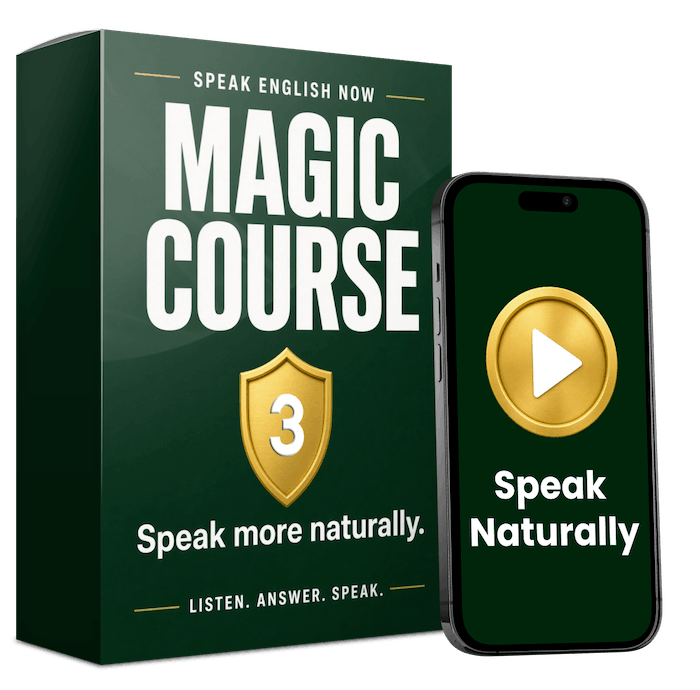
By the way, if you enjoy learning English with stories, you may also like my Magic Course.
It’s a little more advanced than the Fluency Course and helps you improve your speaking and fluency through listening and repetition.
The story is inspired by another famous classic, The Wizard of Oz.
You can learn more at SpeakEnglishPodcast.com/courses
Okay. Now let’s practice with a Point of View lesson inspired by Alice in Wonderland.
First, I’ll tell you what will happen to Alice tomorrow, so I’ll use the future.
Then, I’ll imagine that I am Alice and tell you what I would do in the same situation.
GRAMMAR IN CONTEXT
POV Story
Read the same story from two points of view and notice how the verbs and pronouns change naturally.
01 · FIRST VERSION
Future Tense - Third Person
Tomorrow afternoon, Alice will be sitting in a park when she sees a white rabbit running near her.
At first, she won’t think much about it.
But then she will notice that the rabbit is wearing a small jacket and carrying a pocket watch.
Alice will become curious and follow it.
The rabbit will disappear down a hole.
Alice will stop for a moment. Following a rabbit into a hole will probably not be a good idea.
But she will do it anyway.
She will fall for a long time and finally land in a strange room.
There will be several doors, but they will all be locked.
Then she will see a very small door and a key on top of a table.
Alice will take the key, but she will be too big to go through the door.
Then she will find a small bottle.
She will drink from it and begin to shrink.
At first, Alice will be happy. Soon, she will be small enough to go through the door.
But then she will remember the key.
It will still be on the table, and now Alice will be too small to reach it.
Then a large smiling cat will appear.
Alice will hope the cat can help her, but instead, it will slowly vanish until only its smile remains.
Alice will be alone again, with a locked door and a key she can’t reach.
Still, she won’t stop.
She will keep exploring because she will want to know what happens next.
02 · SECOND VERSION
Conditional - First Person
Now, imagine that I were Alice.
If I were sitting in a park and saw a white rabbit running near me, at first I probably wouldn’t think much about it.
But then I would notice that the rabbit was wearing a small jacket and carrying a pocket watch.
I would become curious and follow it.
If the rabbit disappeared down a hole, I would stop for a moment. Following a rabbit into a hole would probably not be a good idea.
But if I were Alice, I would probably do it anyway.
I would fall for a long time and finally land in a strange room.
There would be several doors, but they would all be locked.
Then I would see a very small door and a key on top of a table.
I would take the key, but I would be too big to go through the door.
Then I would find a small bottle.
I would drink from it and begin to shrink.
At first, I would be happy. Soon, I would be small enough to go through the door.
Then I would remember the key.
It would still be on the table, and now I would be too small to reach it.
Then a large smiling cat would appear.
I would hope the cat could help me, but instead, it would slowly vanish until only its smile remained.
I would be alone again, with a locked door and a key I couldn’t reach.
Still, I would keep exploring.
I would keep exploring because I would want to know what happened next.
Listen to this Point of View lesson several times. You don’t need to study every verb. Just listen and notice how the language changes.
With enough repetition, these patterns become more natural. And you can learn grammar in context.
Thanks for listening, and I’ll see you in the next episode.
Review
Vocabulary
Review the most useful words and expressions before listening again.
curious
wanting to know more about something.
peculiar
strange or unusual.
to vanish
to disappear.
to shrink
to become smaller.
nonsense
something that doesn’t make sense.
ridiculous
very silly or unreasonable.

Continue practicing with my complete English courses. Choose the course that fits your level and goals, and learn to speak more naturally and confidently.