
Episode 377
Listen to the Episode
Listen once for the main idea. Then use the transcript and repeat useful sentences aloud.
Download and study
Episode Resources
Download a file or continue to the transcript.
Best order: listen once, read while listening, then listen again without the text.
Full lesson
Read the Transcript
Follow the text while you listen, then repeat useful sentences aloud.
In this episode, I’m going to show you how to keep talking in English.
After that, we’ll practice with a mini-story.
Let’s get started!
Many English learners have the same problem.
At the beginning, the conversation is fine.
They answer one question.
Maybe two.
And then it stops.
For example:
“Where are you from?”
“Spain.”
“Do you live in Madrid?”
“Yes.”
And then… silence.
Why does this happen?
Because many students think like this:
“I need more vocabulary.”
“I need better grammar.”
“I need better English.”
But that’s not true.
You do not need advanced English.
You do not need perfect grammar.
You do not need difficult words.
You only need a few simple tools.
Today, I’m going to give you five easy ways to keep talking in English.
1. Show interest
This is very important.
If you want a conversation to continue, show interest.
You can say:
“Really?”
“Oh, nice!”
“That’s interesting!”
“No way!”
“That sounds great!”
These expressions are short.
They are simple.
And they work very well.
For example, somebody says:
“I went to Scotland last summer.”
You can say:
“Oh, really? That’s interesting!”
Now the conversation feels alive.
But if you only say, “Aha…”
Well… the conversation may die a quick and painful death.
2. Ask one more question
This is a simple idea.
When the other person says something, ask one more question.
Just one.
For example:
“I have two children.”
“Oh, really? How old are they?”
“I work in a hospital.”
“Really? What do you do there?”
“I love Italian food.”
“Oh, nice! What’s your favorite dish?”
That’s all.
You do not need an amazing question.
You just need a simple question.
One more question keeps the conversation going.
3. Repeat a key word
This is a great trick.
The other person says something.
You repeat one key word.
Like this:
“I’m going to Japan next month.”
“Japan? Really?”
“I started a new job.”
“A new job?”
“I bought an electric bike.”
“An electric bike?”
Very easy.
This gives you time to think.
And it helps the other person continue.
Simple. Natural. Effective.
4. Use follow-up expressions
Some expressions help people talk more.
For example:
“What happened next?”
“How was it?”
“Why?”
“What do you mean?”
“And then?”
“Tell me more.”
Let’s say someone says:
“I had a terrible day yesterday.”
You can say:
“Oh no. What happened?”
Or:
“Really? Tell me more.”
And now the conversation continues.
5. Share a little, then ask back
A conversation is like tennis.
One person speaks.
Then the other person speaks.
If you only say one word, the ball drops.
If you speak for ten minutes without stopping, that is not tennis. That is a speech.
So here is a good strategy:
Say something short about yourself.
Then ask back.
For example:
“I love coffee too. I usually drink two cups in the morning. What about you?”
Or:
“Yes, I’ve been to London once. I loved it. Have you been there many times?”
This makes the conversation feel natural.
And friendly.
So let’s review:
Show interest.
Ask one more question.
Repeat a key word.
Use follow-up expressions.
Share a little, then ask back.
That’s it.
You do not need perfect English.
You just need curiosity.
And a few simple expressions.
Good conversations are not made with difficult words.
They are made with interest.
Okay! Let’s move on to the mini-story.
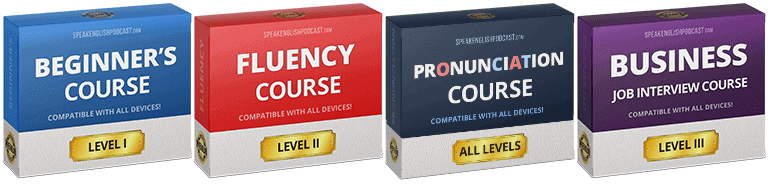
Continue practicing with my complete English courses. Choose the course that fits your level and goals, and learn to speak more naturally and confidently.
IMPROVE YOUR SPEAKING
Mini-Story: Speaking Practice
Answer the questions aloud with short and quick responses. Repeat the Mini-Story several times to improve your speaking and listening.
Let’s start!
Tom went to a language exchange in the city center.
Did Tom go to a hospital?
No, Tom didn’t go to a hospital. He went to a language exchange in the city center.
Did Tom go to a language exchange?
Yes, Tom went to a language exchange in the city center.
Did Tom go to the city center or to the moon?
Tom went to the city center. He didn’t go to the moon.
Who went to a language exchange?
Tom. He went to a language exchange.
Tom wanted to meet people and practice his English.
Did Tom want to practice his Chinese?
No, Tom didn’t want to practice his Chinese. He wanted to practice his English.
Did Tom want to meet people?
Yes, Tom wanted to meet people.
What did Tom want to practice?
Tom wanted to practice his English.
Did Tom want to sit alone and talk to a sandwich?
No, Tom didn’t want to sit alone and talk to a sandwich. He wanted to meet people and practice English.
At first, Tom felt nervous. He only said, “Yes,” “No,” and “Maybe.”
Did Tom feel confident at first?
No, Tom didn’t feel confident at first. He felt nervous.
Did Tom speak in long, romantic sentences?
No, Tom didn’t speak in long, romantic sentences. He only said, “Yes,” “No,” and “Maybe.”
What did Tom say?
Tom said, “Yes,” “No,” and “Maybe.”
Did Tom sound a little like a confused robot?
Yes, Tom sounded a little like a confused robot.
Then a woman named Emma started talking to him.
Did a penguin named Carlos start talking to him?
No, a penguin named Carlos didn’t start talking to him. A woman named Emma started talking to him.
Was her name Emma?
Yes, her name was Emma.
Who started talking to Tom?
Emma started talking to Tom.
Did Emma run away after two seconds?
No, Emma didn’t run away after two seconds. She started talking to Tom.
Emma said, “I’m from Ireland,” and Tom said, “Ireland? Really?”
Did Emma say, “I’m from Italy”?
No, Emma didn’t say she was from Italy. She said she was from Ireland.
Did Tom repeat the key word?
Yes, Tom repeated the key word. He said, “Ireland? Really?”
What country did Emma mention?
Emma mentioned Ireland.
Did Tom say, “Potato? Really?”
No, Tom didn’t say, “Potato? Really?” He said, “Ireland? Really?”
Emma smiled and talked more about Dublin.
Did Emma get angry?
No, Emma didn’t get angry. She smiled and talked more.
What city did Emma talk about?
She talked about Dublin.
Why did Emma talk more?
Emma talked more because Tom showed interest.
Did Emma start talking about her sixteen pet crocodiles?
No,no. She talked about Dublin.
Then Tom asked, “What’s your favorite thing about living there?”
Did Tom ask a follow-up question?
Yes, Tom asked a follow-up question.
What did Tom ask?
He asked, “What’s your favorite thing about living there?”
Was it a simple question?
Yes, it was a simple question.
Did Tom ask about nuclear physics and banana economics?
No, no. He asked a simple follow-up question.
Emma answered, “The people, the music, and the atmosphere.”
Did Emma say, “The people, the music, and the atmosphere”?
Yes, said, “The people, the music, and the atmosphere.”
What did Emma mention?
She mentioned the people, the music, and the atmosphere.
Did she mention bad traffic and angry pigeons?
No, she didn’t mention that. She mentioned the people, the music, and the atmosphere.
Did Tom now have more things to talk about?
Yes, Tom had more things to talk about.
Then Tom said, “That sounds great. I love live music too. What kind of music do you like?”
Did Tom share a little about himself?
Yes, Tom shared a little about himself.
Did Tom ask another question?
Yes, Tom asked another question.
Was Tom balancing the conversation?
Yes, Tom was balancing the conversation.
Did Tom suddenly jump onto the table and sing opera?
No, no. He didn't do that. He continued the conversation normally.
Ten minutes later, Tom was speaking more easily. He wasn’t so nervous anymore.
Was Tom more relaxed ten minutes later?
Yes, Tom was more relaxed ten minutes later.
Was he speaking more easily?
Yes, he was speaking more easily.
How did Tom feel?
Tom felt better. He felt more comfortable.
At the end of the evening, Tom realized something important: he didn’t need perfect English. He just needed curiosity and a few simple expressions.
Did Tom realize he needed perfect English?
No, Tom didn’t realize he needed perfect English.
What did Tom really need?
Tom needed curiosity and a few simple expressions.
Did Tom need twenty-seven phrasal verbs, a British accent, and a gold dictionary?
No, Tom didn’t need twenty-seven phrasal verbs, a British accent, and a gold dictionary. He needed curiosity and a few simple expressions. That's it!
Review
Vocabulary from This Episode
Review the most useful words and expressions before listening again.
show interest
use a short reaction to demonstrate that you are listening.
ask one more question
continue with one simple question about what the person said.
repeat a key word
repeat an important word to show interest and give yourself time to think.
follow-up expression
a phrase such as “What happened next?” or “Tell me more.”
ask back
share something briefly and then return the question to the other person.
curiosity
a genuine desire to learn more about a person or subject.
language exchange
a meeting where people practice different languages together.
Continue practicing with my complete English courses. Choose the course that fits your level and goals, and learn to speak more naturally and confidently.

So amazing audio !! That is to say, it’s lts simple, easier, usefully, moreover it had a good sound, perfect phonetic, the vocabulary is wonderful and mint story, I suggest us, create other similar since they are excited, blessing , get it together
This is very good for those who are shy or low confidence to speak English especially the way you explain and encourage learner to continue practices .This will help me and insisted to show interested.I will follow you.
Good
Thank you so much. It actually is a useful lesson with essential techniques for speaking.