Episode 231
Listen to the Episode
Listen once for the main idea. Then use the transcript and repeat useful sentences aloud.
Download and study
Episode Resources
Download a file or continue to the transcript.
Best order: listen once, read while listening, then listen again without the text.
This episode revisits an earlier Speak English Now lesson: Episode 184 — Things Not to Say.
Full lesson
Read the Transcript
Follow the text while you listen, then repeat useful sentences aloud.
Hi, everybody! I am Georgiana, your English teacher and founder of SpeakEnglishPodcast.com. My mission is to help you speak English fluently.
In this episode, let's look at some bad strategies and attitudes that don't quite work in conversation. I mean, like having awkward conversations.
All right, have you ever been with someone and not known what to talk about? It has happened to me sometimes. Every once in a while, we run into situations where it's difficult to continue the conversation.
One example is what happens in an elevator. Imagine that you meet a neighbor you hardly know, and a typical dialogue ends up going like this:
—Good morning.
—Good morning.
—Going down?
—Yes.
...
It's cold today, isn't it?
Yes, yes. It's going to be like this all week, they say...
...
As you can see, this conversation is not very intellectual. It's more about avoiding silence, which can be uncomfortable.
This doesn't just happen in elevators but in all kinds of social interactions. I read recently that a silence of four seconds or more triggers anxiety.
It doesn't get any better when you have to speak in a language you are learning. You have even fewer resources to express yourself.
Today we are going to see which topics or strategies do not work well in conversations, especially with strangers. The goal, I think, is to have a somewhat interesting conversation.
Talking About the Weather
Talking about the weather is not a bad thing, but if we only talk about it or any other obvious things, we are not going to make a good impression.
Now I can think of a couple of situations where talking about the weather is an awful strategy.
A first date
Talking for 45 minutes about whether it's raining or hot or cold or windy isn't going to make you more attractive.
Job interview
Let's see...you don't know what to say...better not start commenting that it's a cold and foggy morning.
However, there are also exceptions. If you have a date with someone who works in meteorology or your job interview is to work as a meteorologist... well, yes, of course, you have to talk about the weather, right?
You Don't Listen
Yeah, I know it seems obvious, but... many people don't know how to listen, and it shows. When you really listen, you can find many ways to continue the conversation engagingly.
Sometimes people just pretend to be listening. They repeat the last part of what you say in the form of a question.
For example:
When I was on vacation in Rome, it rained all week.
The whole week?
Yes, and we had to buy umbrellas.
Umbrellas?
Yes, and Bill Gates gave us all his money.
All his money?
Yeah... and you don't listen.
I don't listen?
Well, you see what I mean, right? Let's continue.
How You Say It
It is not only important what to say, but how to say it. The most common mistakes are:
Talking too fast. Sometimes people need a slower pace to understand the message better. Not everyone is familiar with what you are saying.
Speaking too softly. Shy people sometimes speak too softly and are hard to understand.
Speaking without articulating clearly. Some people do not pronounce well, and it is difficult to follow what they say. It's better to speak clearly.
Speaking without pausing. It is better to pause from time to time and observe how the other person reacts.
Talking About Something Negative
Another mistake that some people make is to talk about a negative topic to strangers. I really don't recommend that.
Talking About Something Boring
I don't think it's a good idea to talk for half an hour about what color you want to paint the bedroom wall. You have to know how to choose your topics. Basically, for you, it can be relevant, but not for the other person.
Making Assumptions
There are many ways to mess things up, but a common one is to assume something is true when it is not.
Let's look at some examples of messed-up conversations:
The first one
Congratulations!
Why?
Well, you're pregnant. How many months?
No, I'm not pregnant.
Oops! The poor woman may have been a few pounds overweight. So, don't assume anything!
The second one
Ah, how beautiful your wife is and how young!
No, she's not my wife. She's my daughter. And she's a minor.
Again... oops! It's better not to assume this kind of thing. In fact, the other way around is also wrong.
Ah, it's good you're coming with your mother.
—She's not my mother. She's my wife.
We also have to be careful with criticism.
Especially when you do not know the type of relationship between the person you are talking to and the one you are criticizing.
For example, if you're at a wedding:
Food is very scarce. Not much money has been spent.
What a pity! I'll tell my brother, who paid for everything.
Now, let’s practice.
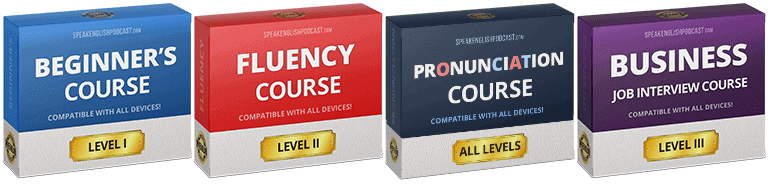
Continue practicing with my complete English courses. Choose the course that fits your level and goals, and learn to speak more naturally and confidently.
IMPROVE YOUR SPEAKING
Mini-Story: Speaking Practice
Answer the questions aloud with short and quick responses. Repeat the Mini-Story several times to improve your speaking and listening.
Fred went into a store to buy a blender to prepare some delicious smoothies.
Fred went into a boat?
No, no. Fred didn't get on a boat. He went into a store.
What did Fred want to buy?
He wanted to buy a blender.
Where did Fred go?
Into a store. He went into a store.
Why did he want to buy a blender?
To prepare some delicious smoothies. Fred wanted to buy a blender to make some delicious smoothies.
Fred saw someone and assumed he was a shop assistant.
A shop assistant saw Fred and assumed he was a customer?
No. That didn't happen. The shop assistant didn't see anything. Fred saw someone and thought he was a shop assistant.
What did Fred assume about the person he saw?
He assumed the person was a shop assistant.
Fred asked the alleged shop assistant for advice on which model to buy.
Did Fred ask his girlfriend to marry him?
No, no. He didn't do that. We don't know if Fred had a girlfriend. He asked the alleged shop assistant for advice.
Who did Fred ask for advice?
The alleged shop assistant. He asked for advice on which blender model to buy.
What advice did he ask?
Which model to buy. Fred asked for advice on which blender model to buy.
The alleged shop assistant replied that he didn't know much about appliances.
Did the shop assistant reply that he was an expert?
No, he didn't. He said that he didn't know much about appliances.
Did he know much about appliances?
He didn't know much. Therefore, he knew little.
Where did this happen?
At the store. This happened at the appliance store.
Fred got mad because he thought the store had lousy service.
Fred got mad?
Yes, he got mad. You could also say he got angry.
Did he get angry because he thought the store had excellent service?
No, the other way around. He got angry because he thought the service was terrible—bad service.
Finally, Fred realized that the alleged shop assistant was also a customer. So, he was very embarrassed.
What did Fred realize? Did he realize that the blender was expensive?
No, not that. He realized that the alleged shop assistant was also a customer.
Did Fred feel proud?
No, no. He didn't feel proud. He felt embarrassed.
Why did he feel embarrassed?
Because the person was actually another customer. Fred had assumed he was an employee. That's why Fred was embarrassed.
Thanks for listening, and I’ll see you in the next episode.
Review
Vocabulary
Review the most useful words and expressions before listening again.
awkward conversation
a conversation that feels uncomfortable or unnatural.
avoid silence
try to prevent a conversation from becoming quiet.
engaging
interesting enough to hold another person’s attention.
articulate clearly
pronounce words distinctly so they are easy to understand.
assume
believe something is true without checking the facts.
mess things up
cause a situation to go wrong or become embarrassing.
alleged
described as something, although it has not been confirmed.
embarrassed
feeling uncomfortable or ashamed because of a mistake.
Continue practicing with my complete English courses. Choose the course that fits your level and goals, and learn to speak more naturally and confidently.