
Episode 389
Listen to the Episode
Listen once for the main idea. Then use the transcript and repeat useful sentences aloud.
Download and study
Episode Resources
Download a file or continue to the transcript.
Best order: listen once, read while listening, then listen again without the text.
Full lesson
Read the Transcript
Follow the text while you listen, then repeat useful sentences aloud.
Hi, everybody! I’m Georgiana, your English teacher and founder of SpeakEnglishPodcast.com.
Recently, one of my students from Singapore asked me a very good question:
“How does listening help me speak English?”
Maybe you’ve wondered the same thing. You probably know that listening is important, but how does it actually help you speak?
When you listen to English that you understand, your brain hears many examples of how English works. You hear common words, useful expressions, pronunciation, rhythm, and the way words naturally go together.
For example, you may hear expressions like:
“I’m not sure.”
“It depends.”
“I didn’t know that.”
“I’ve never done that before.”
When you hear expressions like these many times, they become familiar. You don’t have to build them word by word. They start to feel natural.
That’s one important way listening helps your speaking. It gives you many examples of real English. Later, when you want to say something, your brain already knows common ways to express the idea.
But listening alone isn’t enough.
When you listen, the English is already there. Your job is to understand it. When you speak, you have to find the words yourself and use them quickly. That takes a different kind of practice.
And this is where Mini-Stories can help.
If you’re new to my method, a Mini-Story is a short story with many easy questions. I tell you a small part of the story, and then I ask you questions about it.
For example, I might say: “Tom went to the store because he needed milk.” Then I ask: “Did Tom go to the bank?” You answer: “No, he didn’t. He went to the store.”
The questions are easy on purpose. It’s not a test. The goal is to make you answer aloud.
You first hear the English. Then you use it yourself. And because I ask several questions about the same story, you hear and use the same words and grammar again and again.
Little by little, answering becomes easier and faster.
So, in a simple way: listening helps you become familiar with English, and Mini-Stories help you practice speaking with that English.
This is also the idea behind my courses. You listen to easy-to-understand English, and then you practice with Mini-Stories and other listening lessons. The goal is to help you speak more naturally and without overthinking.
I have courses for fluency, pronunciation, and business English. And I’ll tell you more about them very soon because I’m preparing something special for September.
But for now, remember this: listening gives you examples of English. Speaking practice helps you use them.
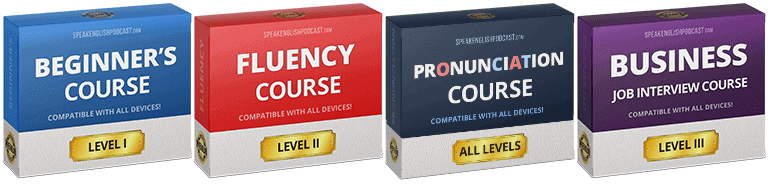
Continue practicing with my complete English courses. Choose the course that fits
your level and goals, and learn to speak more naturally and confidently.
Now, let’s practice with a Mini-Story.
SPEAKING PRACTICE
Mini-Story
Answer each question out loud. Then listen to the answer and respond quickly. Don’t worry about mistakes.
There was a guy named Sam. Sam worked at a hotel.
Was there a guy named Alex?
No. There wasn’t a guy named Alex. Sam was the name of the guy.
Did Sam work at a restaurant?
No, he didn’t. Sam didn’t work at a restaurant. He worked at a hotel.
Where did Sam work?
At a hotel. Sam worked at a hotel.
Sam met guests from many different countries, and many of them spoke English.
Did Sam meet people from only one country?
No, he didn’t. He met people from many different countries.
What language did many of the guests speak?
English. Many of the guests spoke English.
Sam could understand them quite well because he listened to English almost every day.
Could Sam understand English quite well?
Yes, he could. He could understand English quite well.
Did Sam listen to English once a month?
No, he didn’t. He listened to English almost every day.
He listened to podcasts while driving and watched short videos in English at home.
What did Sam listen to while driving?
Podcasts. He listened to podcasts while driving.
Did he also watch videos in English?
Yes, he did. He watched short videos in English at home.
But speaking was harder for Sam. When a guest asked him a question, he often knew what he wanted to say, but he needed too much time to answer.
Was speaking easier for Sam?
No, it wasn’t. Speaking was harder for him.
Did Sam usually know what he wanted to say?
Yes, he did. He often knew what he wanted to say.
So what was the problem?
He needed too much time to answer in English.
Sam wanted to speak faster, so he started answering simple questions aloud for a few minutes every day.
Did Sam stop listening to English?
No, he didn’t. He continued listening, but he also started answering questions aloud.
Did he answer only in his head?
No, he didn’t. He answered aloud. He used his voice.
Were the questions very difficult?
No, they weren’t. They were simple questions.
At first, Sam had to stop and think. But after a few weeks, his answers became faster.
Was Sam very fast at the beginning?
No, he wasn’t. At first, he had to stop and think.
Did his answers become slower after a few weeks?
No, they didn’t. They became faster.
One evening, an American guest asked Sam, “Is there a good restaurant near here?”
Did the guest ask about a train station?
No, he didn’t. He asked about a good restaurant.
Did Sam understand the question?
Yes, he did. He understood it right away.
This time, Sam didn’t freeze. He answered right away and explained that there was a good restaurant two blocks from the hotel.
Did Sam need a long time to answer?
No, he didn’t. He answered right away.
Was the restaurant twenty miles away?
No! It wasn’t twenty miles away. It was only two blocks from the hotel.
The guest thanked Sam, and Sam felt great.
Did the guest get angry?
No, he didn’t. He thanked Sam.
Why did Sam feel great?
Because he’d understood the question and answered quickly in English.
Sam hadn’t suddenly learned hundreds of new words. He’d practiced using the English he already understood.
Had Sam learned hundreds of new words in a few weeks?
No, he hadn’t. He’d simply become faster at using the English he already knew.
And that’s exactly what you’re doing when you answer the Mini-Story questions aloud.
Remember: listen to English you understand, listen more than once, and answer the Mini-Story questions aloud. You don’t need to be perfect. You just need to practice.
Review
Vocabulary
Review the most useful words and expressions before listening again.
familiar
something you know well because you’ve heard or seen it before.
to freeze
to suddenly be unable to speak or act.
rhythm
the natural beat and flow of speech.
right away
immediately; without waiting.
Continue practicing with my complete English courses. Choose the course that
fits your level and goals, and learn to speak more naturally and confidently.

Hi,i listen to your padcast for, is that enough for listening?
Hi! 😊 Yes, listening to my podcast regularly is a very good way to improve your listening.
Try to listen often, and don’t worry if you don’t understand everything at first. You can also listen to the same episode more than once. This really helps your brain get used to English.
If you want to improve your speaking too, make sure you answer the Mini-Story questions out loud. That part is very important because it helps you start speaking more automatically.
And if you want more structured practice, my premium courses go deeper and give you many more Mini-Stories and speaking exercises.
Keep going! You’re doing the right thing. 😊