Episode 3
Listen to the Episode
Listen once for the main idea. Then use the transcript and repeat useful sentences aloud.
Download and study
Episode Resources
Download a file or continue to the transcript.
Best order: listen once, read while listening, then listen again without the text.
Full lesson
Read the Transcript
Follow the text while you listen, then repeat useful sentences aloud.
Hi, everybody! I’m Georgiana, founder of SpeakEnglishPodcast.com. My mission is to help you speak English fluently with no grammar and no textbooks.
Today, we’re going to talk about something very important.
How many times should you listen to the same English audio?
Once? Twice? Ten times? Twenty times?
And after that, we’ll practice speaking with a Mini-Story.
English learners have a strange problem today.
There isn’t too little material. There’s too much.
You can listen to podcasts, watch videos, follow different teachers, and listen to many different accents.
New material can feel useful, but fluency needs repetition.
And new material can feel useful. You think, “I’m learning more.”
Think about learning to play an instrument.
My husband recently started learning to play the piano. And I remember hearing him practice the same song again and again.
The same melody. The same parts. The same notes.
Sometimes I had to be patient because I heard the same song many times!
Building a skill
But that repetition was necessary. He wasn’t wasting time by playing the same thing again and again. He was building a skill.
Little by little, the music became more natural.
Learning English works in a similar way.
You don’t become fluent by always searching for something new.
But after teaching English for many years now, and talking to students from all over the world, I see the same problem again and again.
They do many different things, sometimes for years, but they still have trouble speaking.
Often, the problem is not effort. It’s focus.
You need to know what you want to accomplish.
If your goal right now is communication and fluency, choose material that helps you with that goal.
Especially if English is still difficult for you to understand and speak, use English that is easy enough for you to follow.
Don’t keep changing teachers, podcasts, topics, and accents all the time.
If you find a speaker you understand well, stay with that speaker for a while.
Use a clear method: listen, understand, respond, and repeat.
This gives your brain time to get used to the words, pronunciation, and sentence patterns.
Why repetition matters
That’s one reason repetition is so important in my method.
With enough exposure to the same material, you hear useful phrases, pronunciation, and sentence patterns many times.
Little by little, they become more familiar, and understanding takes less effort.
Let’s say you’re a beginner or lower-intermediate learner.
Imagine you have a short five-minute audio at your level.
How many times should you listen?
Maybe twenty times. Maybe thirty. Maybe even more.
Yes, you heard that right.
But I’m not saying you should do it all in one day.
You could listen to the same audio three times a day for one week.
The first time, maybe you understand the main idea. Later, you notice phrases and pronunciation that you missed before.
After several listens, the English starts to feel more familiar.
You begin to understand without translating every word.
That’s the goal.
And repetition doesn’t mean you have to sit at a desk.
You can listen while walking, driving, cooking, or cleaning.
Consistency is more important than doing a huge amount in one day.
Okay. Let’s practice.
Stay with useful English long enough for it to become familiar.
Don’t keep searching for something new every day.
Listen. Understand. Respond. Repeat.
That is how fluency grows.
Okay. Now let’s practice with a Mini-Story.
Remember: I’ll give you some information. Then I’ll ask you very easy questions. Try to answer out loud before I give you the answer.
Let’s start!
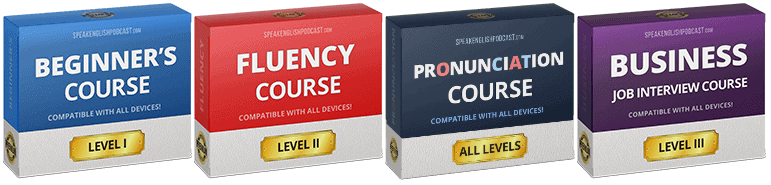
Continue practicing with my complete English courses. Choose the course that fits your level and goals, and learn to speak more naturally and confidently.
IMPROVE YOUR SPEAKING
Mini-Story: Speaking Practice
Answer the questions aloud with short and quick responses. Repeat the Mini-Story several times to improve your speaking and listening.
Peter the Penguin had a dream. He wanted to become a movie star.
Did Peter have a dream?
Yes. Peter had a dream.
Was Peter a penguin?
Yes. Peter was a penguin.
Did Peter want to become a movie star or a doctor?
A movie star. Peter wanted to become a movie star.
One day, Peter got his first role in a movie. He was very excited.
Did Peter get his first role?
Yes. He got his first role.
Was he excited?
Yes. He was excited.
Did he get his first role in a movie or in a restaurant?
In a movie. He got his first role in a movie.
But Peter had a problem. He had to say one sentence in English.
Did Peter have a problem?
Yes. He had a problem.
Did he have to say one sentence or one hundred sentences?
One sentence. He had to say one sentence.
What did Peter have to say?
One sentence in English.
The sentence was: "My name is Peter."
What was Peter's sentence?
"My name is Peter."
Was the sentence long or short?
Short. It was short.
Peter practiced the sentence every day.
Did Peter practice the sentence every day?
Yes. He practiced it every day.
Did he practice a different sentence every day?
No. He practiced the same sentence.
What sentence did he practice?
"My name is Peter."
At first, Peter had to think before speaking.
Did Peter speak automatically at first?
No. He didn't.
Did he have to think before speaking?
Yes. He had to think before speaking.
But after many repetitions, the sentence became easier and more natural.
Did the sentence become easier or more difficult?
Easier. It became easier.
Did Peter still need to think a lot before saying it?
No. He didn't.
Finally, the day of the movie arrived. Peter walked onto the stage and said: "My name is Peter."
Did Peter forget his sentence?
No. He didn't forget it.
What did Peter say?
"My name is Peter."
The movie was a huge success. Everyone loved Peter the Penguin.
Was the movie successful?
Yes. It was successful.
Did people like Peter?
Yes. They liked Peter.
The director wanted to make another movie.
Did the director want to make another movie?
Yes. He did.
Did he want to make another movie or stop making movies?
Another movie. He wanted to make another movie.
The second movie was called: "My Name Is Peter 2."
Was the second movie called "My Name Is Peter 2"?
Yes. It was.
Did it have a completely different name?
No. It had almost the same name.
Peter was happy because he had a new movie. But he had the same sentence.
Did Peter have many new sentences?
No. He had the same sentence.
What sentence did he have?
"My name is Peter."
Peter became the most famous penguin actor in the world.
Did Peter become famous?
Yes. He became famous.
Was he famous because he was a penguin?
Yes. He was famous because he was a penguin actor.
Excellent!
That's the end of the Mini-Story.
Remember, you can listen to this section again and answer the questions several times.
The questions are easy on purpose. The goal is to help you respond quickly and automatically in English.
And don't worry too much about listening to something new every day.
Listen to a lot of English you can understand. Repeat the same episodes, practice speaking, and focus on being clear and confident.
And if you want more structured listening and speaking practice, you can check out my premium courses at
SpeakEnglishPodcast.com/courses. There are several levels.
Thanks for listening, and I'll see you in the next episode!
Bye-bye!
Review
Vocabulary
Review the most useful words and expressions before listening again.
material
Things you can use to learn, like audio, videos, or podcasts.
repetition
Doing, hearing, or saying something again and again.
skill
An ability you develop with practice.
fluency
The ability to speak easily and naturally, without long pauses.
focus
The attention you give to one goal or activity.
method
A particular way of doing or learning something.
familiar
Easy to recognize because you have seen or heard it before.
consistency
Doing something regularly over a period of time.
automatically
Happening quickly without thinking much; in a natural way.
role
A part an actor plays in a movie.
practice
Repeating something to get better at it.
exposure
Contact with English through listening or reading many times.
sentence
A group of words that express a complete idea.
success
A good result after effort.
Continue practicing with my complete English courses. Choose the course that fits your level and goals, and learn to speak more naturally and confidently.