Episode 175
Listen to the Episode
Listen once for the main idea. Then use the transcript and repeat useful sentences aloud.
Download and study
Episode Resources
Download a file or continue to the transcript.
Best order: listen once, read while listening, then listen again without the text.
Full lesson
Read the Transcript
Follow the text while you listen, then repeat useful sentences aloud.
Hi, I am Georgiana, your English teacher and founder of SpeakEnglishPodcast.com. And I am here to help you speak English fluently with no grammar and no textbooks.
In this episode, let’s find out if you are too old to learn English?
Is it too late to learn a language? Is it possible to learn English as an adult? I'm going to answer these questions.
- In the second part, we are going to meet Tom and his adventures to learn English.
Ok. Let's start!
Some time ago, a 95-year-old student from Greece sent me an email. He wanted to tell me how my method helped him learn English.
He is learning English and listens to this podcast. The truth is that I admire people who don't make excuses. And that's what inspired me to do this episode.
There is a widespread belief that if you don't start learning a language when you are very young - ideally as a child - it is practically impossible to learn it.
Some even bash those who are studying a language, saying things like:
"You're wasting your time and your money!"
"Unless you go to the country, you'll never learn the language!"
Well, I'm here to tell you that's a myth. You can learn English as an adult and become fluent in English. Many of my students have learned English at an advanced age and are perfectly able to speak it fluently.
Children indeed seem to learn their mother tongue effortlessly.
The younger you are, the easier it is to create new brain connections and consequently learn anything quickly.
However, studies show that the brain never loses the ability to learn.
For me, the determining factor is the attitude, not aptitude.
Attitude refers to how we feel about something. Aptitude, relates to the ability to do something.
A bad attitude - that is, being negative, complaining, or making excuses - will not help you learn anything. It is crucial to have a good predisposition to learn. In other words, be more positive and less negative. Sometimes this bad attitude leads to limiting oneself. For example, some people think:
"I am not good at learning languages."
"I am too old for this."
Certainly, this attitude does not help at all. On the other hand, children usually have a good attitude.
For example, they never say things like:
"But there are so many words I don't know yet!"
"I make a lot of mistakes! People are going to laugh at me!"
“I will never speak English! I'd better not even try!"
In reality, kids don't care how long it takes, how many mistakes they make, or whether they mispronounce a word. In fact, kids hardly get frustrated when they don't get something right the first time.
They just keep trying. They don't set mental limits for themselves as we adults do.
So, I recommend you to be inspired by the attitude of the 95-year-old student I mentioned before.
Ok, let’s continue with a mini-story.
Now, let’s practice.
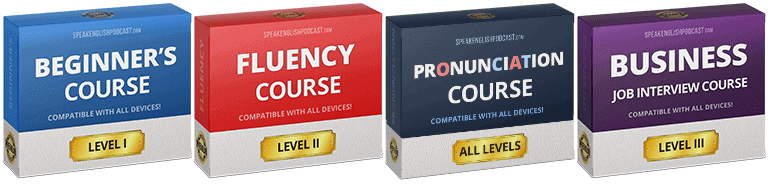
Continue practicing with my complete English courses. Choose the course that fits your level and goals, and learn to speak more naturally and confidently.
IMPROVE YOUR SPEAKING
Mini-Story: Speaking Practice
Answer the questions aloud with short and quick responses. Repeat the Mini-Story several times to improve your speaking and listening.
Tom is learning English and is embarrassed to speak it.
Is Tom embarrassed to wear a bathing suit because he is fat?
No, no. Tom is not embarrassed to wear a bathing suit because he is fat. He is embarrassed to speak English.
What is Tom learning?
English. He is learning English.
What is Tom embarrassed about?
About speaking English. He is embarrassed to speak English.
Tom is afraid of being laughed at if he makes a mistake.
Is Tom afraid of being laughed at for his jokes?
No. He is not afraid of that. He is afraid of being laughed at.
If Tom makes a mistake, is he afraid of being laughed at?
Yes. Tom's afraid of being laughed at if he makes a mistake.
What is Tom afraid of?
Of being laughed at. Tom's afraid of being laughed at.
Tom comes up with a plan: after every sentence, he says, "ha!"
Does Tom come up with a plan or a clan?
A plan. Tom comes up with a plan. He devises a plan.
Does Tom say anything before each sentence?
Yes. Tom says something after each sentence. He says, "ha!"
Is Tom crazy?
Well, we don't know, but Tom seems a little strange.
And people only pay attention to that strange "ha!" sound, not to Tom's mistakes when he speaks.
Do people pay attention to that strange sound?
Yes. People only pay attention to that strange sound. They no longer pay attention to Tom's mistakes when he speaks.
What are people not paying attention to? Tom's mistakes. People don't pay attention to his mistakes anymore. They just pay attention to that strange sound, "ha!"
Finally, Tom can speak English without feeling embarrassed.
Does Tom feel embarrassed?
No, he doesn't feel embarrassed. He can speak the language without feeling embarrassed.
Who can speak without feeling embarrassed?
Tom. Tom can speak without feeling embarrassed.
What can he speak without feeling ashamed?
English. Tom can speak English without feeling ashamed.
However, Tom doesn't understand people's surprised looks.
Does Tom understand people's surprised looks?
No, he doesn't. He doesn't understand those surprised looks.
How do people look at Tom?
They look at him with surprised looks.
Thanks for listening, and I’ll see you in the next episode.
Review
Vocabulary
Review the most useful words and expressions before listening again.
too old to learn
believing age prevents learning.
widespread belief
an idea accepted by many people.
make excuses
give reasons for avoiding action.
bash someone
criticize someone harshly.
embarrassed
feeling uncomfortable or ashamed.
adult learner
a grown person studying a new skill.
surprised look
a facial expression showing surprise.
keep learning
continue developing knowledge or skill.
Continue practicing with my complete English courses. Choose the course that fits your level and goals, and learn to speak more naturally and confidently.