Episode 81
Listen to the Episode
Listen once for the main idea. Then use the transcript and repeat useful sentences aloud.
Download and study
Episode Resources
Download a file or continue to the transcript.
Best order: listen once, read while listening, then listen again without the text.
Full lesson
Read the Transcript
Follow the text while you listen, then repeat useful sentences aloud.
Hi everyone! I'm Georgiana, founder of SpeakEnglishPodcast.com. My mission is to help you speak English fluently. Speaking English is easier than it seems. You just have to use the right material and techniques.
Today I'll talk about grammar and English fluency.
Is grammar important?
Do you really need to study grammar?
Before I go any further, I'd like to thank you for listening. I'm also a language learner, and I can identify with you and your goals, so I want to help you.
Your help would mean a lot to me!
Let me share a review of a student named Cata Lina:
"I'm a language teacher in my home country, and this method is an easy and very intelligent way to learn English. The use of Questions and Answers and The Point of view is the correct way to learn a language. Georgiana really cares about the people who use her method because we can learn effectively. "
Thanks, Cata Lina! I'm happy to know that my method is helping you with your English.
All right. Now let's get started:
Are you a frequent listener of the Speak English Now podcast?
Then I'm sure you're more than familiar with the opening of the show:
"Speak English Now fluently with no grammar and no textbooks."
That's right. I help my students to speak English fluently without grammar. And still, people ask me from time to time:
"Is grammar essential?"
"Should I learn grammar?"
My short answer is: No, it's not essential. And you shouldn't learn grammar.
Let me elaborate on my answer a bit more.
First of all, if you want to speak English fluently, you don't need to study grammar.
Here's why:
When children learn to speak, they don't study grammar. Kids only listen enough times to the same patterns, the same words. It's that simple.
Grammar doesn't help in real conversations because you don't have time to apply complicated rules when speaking.
Textbooks are usually designed to help you pass an exam, but they don't help you to speak English.
So, am I saying that you shouldn't learn grammar at all?
Well, not exactly. Grammar can be useful when you don't know anything about a language or when you want to pass an exam.
But I've got good news for you. With my lessons, you'll learn grammar without studying grammar.
Yes. That's right! In my courses, I use a technique called The Point of View Lesson. If you've listened to some episodes of the podcast, you're already familiar with this method.
Basically, I tell a short story several times, changing the linguistic point of view.
For example, I tell the same story to you in the past, present, and future tense or plural and singular.
This system works incredibly well. It helps you use grammar intuitively and without making errors.
Therefore, you will not study grammar. Still, you will learn grammar.
What most English learners do is to study a lot of grammar and do all kinds of textbook exercises: filling the gaps, matching lists, etc. Perhaps this sounds familiar to you.
And the logical thing after months of hard work is to have a conversation in English.
So, you're excited and ultimately hire a private English tutor.
But, to your surprise, things go worse than you expected. You begin to realize that you can't follow a conversation in English; because every time you try to speak, you make silly mistakes, or you can't finish most sentences.
This is the turning point where most students give up.
So, you must keep in mind that the effort or time you put into learning English is not the only essential factor. Without the right method, you won't become fluent.
That being said, your fluency in English is not based on grammar but rather on the amount of time you listen.
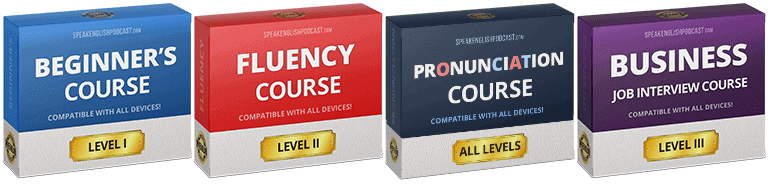
Continue practicing with my complete English courses. Choose the course that fits your level and goals, and learn to speak more naturally and confidently.
GRAMMAR MADE EASY
POV Story: Grammar in Context
Read the same story in two different points of view and notice how the grammar changes naturally.
| 01 |
First version Third Person · Past Tense |
Tom was the only accountant in a large corporation. Academically, he was remarkably well-prepared. He had a lot of work to do. Every day he calculated, classified, consulted, and evaluated all kinds of accounting aspects. Also, he made all kinds of decisions without making mistakes.
Still, Tom was unhappy with his situation, although he was very popular within the company.
He was the perfect employee. But he was not motivated.
So one day, Tom concluded that his work was superficial, and he decided to quit.
Tom created a new business open to the public called "The Delicious Chocolate Family House." There he merely offered a collection of the best chocolate in the world.
His business was particularly appealing to family members who regularly held all kinds of events.
After that change, Tom was more motivated than ever because he no longer calculated, classified, consulted, or evaluated. He just enjoyed life.
| 02 |
Second version Third Person · Present Tense |
Tom is the only accountant in a large corporation. Academically, he is remarkably well-prepared. He has a lot of work to do. Every day he calculates, classifies, consults, and evaluates all kinds of accounting aspects. Also, he makes all kinds of decisions without making mistakes.
Still, Tom is unhappy with his situation, although he is very popular within the company.
He is the perfect employee. But he's not motivated.
So one day, Tom concludes that his work is superficial and decides to quit.
Tom creates a new business open to the public called "The Delicious Chocolate Family House." There he merely offers a collection of the best chocolate in the world.
His business is particularly appealing to family members who regularly hold all kinds of events.
Now Tom is more motivated than ever because he no longer calculates, classifies, consults, and evaluates. He just enjoys life.
Thanks for listening, and I’ll see you in the next episode.
Review
Vocabulary
Review the most useful words and expressions before listening again.
Fluency
The ability to speak smoothly and naturally with little hesitation.
Pattern
A repeated language structure that becomes familiar through listening.
Point of View Lesson
A technique that tells the same story from different grammatical perspectives.
Intuitively
In a natural way without consciously thinking through rules.
Linguistic point of view
The grammatical perspective used to tell a story, such as past, present, future, singular, or plural.
Fill in the gaps
A common textbook exercise where missing words are added to sentences.
Turning point
A moment when a situation changes significantly.
Give up
To stop trying because something feels too difficult or discouraging.
Continue practicing with my complete English courses. Choose the course that fits your level and goals, and learn to speak more naturally and confidently.