
Episode 40
Listen to the Episode
Listen once for the main idea. Then use the transcript and repeat useful sentences aloud.
Download and study
Episode Resources
Download a file or continue to the transcript.
Best order: listen once, read while listening, then listen again without the text.
Full lesson
Read the Transcript
Follow the text while you listen, then repeat useful sentences aloud.
Hi, everyone!
I'm Georgiana, founder of SpeakEnglishPodcast.com. My mission is to help YOU to speak English fluently and confidently.
Today I'll talk about correction when speaking English and how it affects your fluency.
Later you'll practice your speaking with a funny mini-story.
Before we get started, I wanted to say hello to a student named Gabriela from Brazil. She wrote a comment saying that she loves the podcast and that she feels that she's having a real conversation when she practices with the lessons.
Hi, Gabriela! Thanks for the comment. It's great that you're using the podcast to improve your listening and speaking! With a little patience, you'll soon notice a significant improvement.
Let's start!
A student asked me this question not long ago:
"Is it effective to be corrected when you speak?"
Let's say you're an English student, and you're trying to practice your speaking. Your first idea is to hire a tutor who will correct all your mistakes.
At first, it seems like a great idea to be corrected. Every time you make a mistake, the tutor will tell you the correct pronunciation, and that's how you'll learn to speak correctly.
Yet, based on my vast experience as an English teacher, I must be honest with you and tell you that this approach isn't practical. In fact, overcorrection prevents you from developing fluency.
And when I talk about fluency, I mean speaking without pausing too often. It's when you're making some mistakes, but you're not continually hesitating.
The problem with being corrected too often is that you're always being interrupted.
For example, you're trying to explain that a friend of yours is getting married.
You start saying: "A friend of me…"
And you haven't even got the chance to say anything else when the tutor already stops to correct you.
He'll say something like this: "No! No! No! No! It's not a "friend of me. It's a friend of mine."
After that, you'll try again: "A friend of me...sorry...a friend of mine...will get married."
I guess that you get the idea.
Because of the early correction, you'll get nervous from the beginning, and you'll forget your ideas.
When students are corrected too many times, they tend to overanalyze what they're saying. They pause very often just to make sure that what they're trying to say is correct. So, they're not thinking about what to say but how to say it. It's really unnatural to communicate like that. That's why speaking becomes frustrating and exhausting for many English students.
I repeat this idea because it's vital. The student isn't thinking about what to say anymore but how to say it.
That's why being corrected too often won't help you develop your English fluency. Every time you try to speak English, you'll become stressed out, and you won't enjoy having a conversation.
Does this mean that you should never be corrected? Well, no, no. That would be extreme. You can be corrected from time to time, and about repetitive errors.
In any case, your tutor could point out these errors at the end of the conversation and allow you to express yourself even when you're making some minor mistakes. It will help you to build up confidence, and you'll feel more relaxed.
Remember how I always tell you to listen, listen, and listen?
Native English speakers never think of rules or regulations when they speak, and they're definitely not worried about how to say things.
And it's because they have been listening to the correct forms thousands of times. They've heard their parents and friends speak correctly; later, they've started watching TV shows and reading books. Does this sound familiar to you? Because that's exactly what you've done with your mother tongue.
That's why native speakers are always capable of speaking without hesitating and without making any mistakes, which is why I constantly urge you to listen a lot to get that intuition of what's right and what's wrong.
Let's move on to the next section.
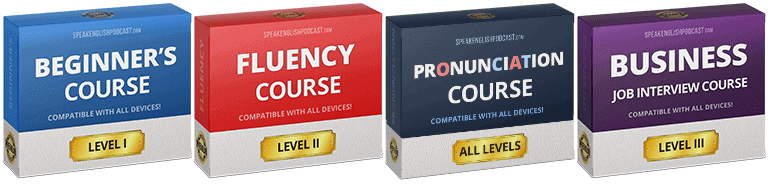
Continue practicing with my complete English courses. Choose the course that fits your level and goals, and learn to speak more naturally and confidently.
IMPROVE YOUR SPEAKING
Mini-Story: Speaking Practice
Answer the questions aloud with short and quick responses. Repeat the Mini-Story several times to improve your speaking and listening.
Jimmy was a 25-year-old man who stuttered when he spoke.
Was Jimmy 24 years old?
No. No. He was a 25-year-old man.
Was Jimmy a man or a boy?
He wasn't a boy. Jimmy was a man.
Did Jimmy speak confidently?
No. No. He didn't speak confidently. Jimmy stuttered when he spoke.
When did Jimmy stutter?
When he spoke, he stuttered when he spoke.
He often wondered how to formulate his sentences correctly.
Did he wonder how to formulate his sentences?
Yes. He wondered how to formulate his sentences.
Did he wonder how to formulate his sentences wrongly or correctly?
Not wrongly but correctly! He wondered how to formulate his sentences correctly.
How many times did he wonder how to formulate his sentences?
Often or rarely?
Not rarely. He often wondered how to formulate his sentences.
People teased and mocked him, so he said fewer and fewer words.
Did people tease him?
Yes. People teased him.
Did people tease and mock Jimmy?
Yes. People teased and mocked Jimmy.
Who was teased and mocked?
Jimmy's brother?
No. No. Not his brother. Jimmy was teased and mocked.
So, Jimmy said more and more words. Right?
No. No. Jimmy didn't say more and more words. He said fewer and fewer words.
One day he invented a smartphone app to help him to speak.
When did he invent a smartphone app?
One day. He invented a smartphone app one day.
Who invented a smartphone app?
Jimmy. He invented a smartphone app.
Why did Jimmy invent an app?
To help him to speak or to read?
He invented the app to help him to speak, not to read.
The app replicated everything he wanted to say. He just had to write.
What did the app do?
The app replicated everything he wanted to say.
Who replicated what he wanted to say?
His friend?
No. No. Not his friend. The app replicated what he wanted to say.
Did Jimmy have to write or to read?
Write. Jimmy just had to write. No to read.
The voice of the app was mesmerizing, and people couldn't stop listening.
How was the app's voice?
Mesmerizing or terrifying?
The app's voice was mesmerizing. I wasn't terrifying.
What was mesmerizing?
Jimmy's voice?
No. No. Not Jimmy's voice. The app's voice was mesmerizing.
Could people stop listening to the app's voice?
No. They couldn't stop listening.
And that's how Jimmy became the most popular speaker in the world.
Did he become popular or unpopular?
Not unpopular. He became the most popular speaker.
Did Jimmy become the most popular speaker in the world?
Yes. Jimmy became the most popular speaker in the world.
Who became the most popular speaker in the world?
Jimmy or his mom?
Not his mom. Jimmy became the most popular speaker in the world.
Thanks for listening, and I’ll see you in the next episode.
Review
Vocabulary
Review the most useful words and expressions before listening again.
Correction
The act of pointing out and fixing a mistake.
Fluency
The ability to speak smoothly without pausing too often.
Overcorrection
Correcting someone so often that it interferes with communication or confidence.
Hesitate
To pause because you are uncertain about what to say.
Overanalyze
To think about something too much or in too much detail.
Repetitive error
A mistake that someone makes again and again.
Build up confidence
To gradually become more confident.
Intuition
A natural sense of what sounds right without consciously applying rules.
Continue practicing with my complete English courses. Choose the course that fits your level and goals, and learn to speak more naturally and confidently.

You are great Georgiana
I love you
Do you really want to teach us!
Thanks!
Dear teacher, Georgiana!
It’s impossible not to listen to your podcast every day. And so I’m improving my learning in English.
Thanks, I live you
I Love you*
Thanks dear teacher Georgiana!
You are an amazing!