
Episode 151
Listen to the Episode
Listen once for the main idea. Then use the transcript and repeat useful sentences aloud.
Download and study
Episode Resources
Download a file or continue to the transcript.
Best order: listen once, read while listening, then listen again without the text.
Full lesson
Read the Transcript
Follow the text while you listen, then repeat useful sentences aloud.
Hi, everybody! I am Georgiana, your English teacher and founder of SpeakEnglishPodcast.com. My mission is to help you speak English fluently.
Today I will talk about fluency and how it is related to the possible mistakes that occur when we speak. Yes. Sometimes we can make mistakes!
Next, we will practice grammar with a funny point of view story. You just have to listen and observe how the different grammar points change.
Very good! I have decided to talk about a topic that I think is very significant for the language student.
First of all, let's see what fluency means.
When a person can speak fluently, they can speak more or less without hesitation, without pausing and thinking about how to say something. Occasionally we can take a short pause to think, but this is not usual.
We experience near-perfect fluency when we speak our mother tongue. If you pay attention to when you speak, you will see that you do not think about which words to use. You just have an idea of what you are going to say, and you say it.
When you are learning a language, fluency develops gradually. A good symptom is when you find yourself without almost translating mentally. At first, it is normal to do so, but little by little, part of your speech becomes automatic, and the words are simply there. That's when you start enjoying more and more conversations with Native speakers. It is amazing to see yourself in a conversation with a Native speaker in the language you are learning.
Somehow, it all becomes real.
Traditional or more academic methods insist on mastering more formal aspects such as grammar rules, word position, or conjugations. According to their theories, learning all this will help you express yourself better and avoid making so many mistakes when speaking.
Ask yourself this question: How often do you think about grammar rules when you speak in your native language?
I believe that the most important thing for a language student is to develop fluency first. This has to be your main goal. When we are in the middle of a conversation, things go very fast. You can't pause for 30 seconds to think about how to structure a sentence. You need to speak at that moment. You need to be fluent.
And how does this relate to mistakes? It's common sense. If you can express yourself more or less effortlessly, mentally, you don't have to look up or translate words. They just come to your mind. This way, you can spend more time focusing on other aspects, such as making fewer mistakes or improving your pronunciation.
As I always say, the way to improve your fluency is mostly by listening. The more you listen, the more you acquire the patterns of the language. When I talk about patterns, I mean word patterns that are very commonly used. So, you no longer think word by word but by groups of words. A very positive effect from listening to content made by a native speaker is that you hear the language without mistakes, so little by little, you will end up using the same structures that are error-free.
In short, developing fluency as the main objective helps us to speak without pausing and without translating mentally. Also, by automating speech, we can spend more time focusing on small mistakes we can make. To improve fluency, you must listen a lot and repeatedly. Contrary to what you thought, the material you listen to has to be easy to understand. You have to comprehend 90% of what you hear. Listening to something you like and can understand easily but for hours and hours will improve your fluency.
By the way, on my website, SpeakEnglishPodcast.com.
Now, let’s practice.
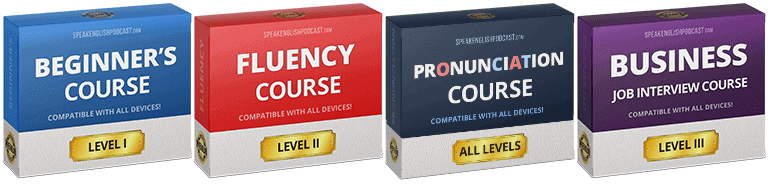
Continue practicing with my complete English courses. Choose the course that fits your level and goals, and learn to speak more naturally and confidently.
GRAMMAR MADE EASY
POV Story: Grammar in Context
Read the same story in two different points of view and notice how the grammar changes naturally.
| 01 |
First version Past Tense |
Matthew was an English student. He went to the United States to practice because he wanted to speak fluently. However, he only read textbooks and grammar books to hold conversations. He always carried a backpack full of textbooks.
To form a single sentence, Matthew needed about 27 minutes on average because he had to check all kinds of grammar rules. Obviously, people got bored with him right away.
One day, Matthew stopped to ask a guy named Tom how to get to a place. After 27 minutes, Matthew managed to say, "Good morning, where is the train station? Oddly enough, Tom was carrying two backpacks full of textbooks and began to open them and consult them. After an hour and a half, Tom said, "Go straight ahead," and left.
Matthew realized that Tom was also an English student and was doing the same as him, but with more intensity. He thought, "How boring it is to talk to a person like that! It only takes me less than 30 minutes to say something! I think that guy is very obsessed with grammar!
| 02 |
Second version Future Tense |
Matthew will be an English student. He will go to Australia to practice because he will want to speak fluently. However, he will only read textbooks and grammar books to talk to people. He will always carry a bag full of textbooks.
To form a single sentence, Matthew will need about 37 minutes on average because he will have to check all kinds of grammar rules. Obviously, people will get bored with him right away.
One day, Matthew will stop to ask a man named Tom how to go somewhere. After 37 minutes, Matthew will manage to say, "Good afternoon, where is the subway station?" Oddly enough, Tom will carry two bags full of books and start opening them and consulting them. Tom will answer him after two hours: "Go straight ahead," and he will leave.
Matthew will realize that Tom will also be an English student and will do the same thing as him, but more decisively. He'll think, "What a bore to talk to a person like that! It only takes me less than 40 minutes to say something! I think that guy is very obsessed with grammar!
Thanks for listening, and I’ll see you in the next episode.
Review
Vocabulary
Review the most useful words and expressions before listening again.
Fluency
The ability to speak smoothly with little hesitation or unnecessary pausing.
Hesitation
A pause caused by uncertainty about what to say.
Mother tongue
Your native language.
Translate mentally
To translate in your head before speaking.
Conjugation
The different forms a verb takes according to tense, person, and other grammatical features.
Effortlessly
With little or no apparent effort.
Language patterns
Common groups or structures of words that are repeatedly used in a language.
Repeatedly
Again and again; the episode recommends listening many times to improve fluency.
Continue practicing with my complete English courses. Choose the course that fits your level and goals, and learn to speak more naturally and confidently.

Congratulations on this wonderful podcast. Could you dedicate a topic to give directions in English? By the way, I have the first two courses and I think they are wonderful. When I finish them I will buy the last one.Greetings!
Thanks! And let me say that I’m so happy you’re enjoying my premium courses.
Hi there. There is a little mistype word in the pdf at the fifth paragraph. The word said is unusual ant the written one is usual.