Episode 192
Listen to the Episode
Listen once for the main idea. Then use the transcript and repeat useful sentences aloud.
Download and study
Episode Resources
Download a file or continue to the transcript.
Best order: listen once, read while listening, then listen again without the text.
Full lesson
Read the Transcript
Follow the text while you listen, then repeat useful sentences aloud.
Hi, everybody! I am Georgiana, your English teacher and founder of SpeakEnglishPodcast.com. My mission is to help you speak English fluently.
Today, in this episode:
We're going to continue to see some bad strategies that I don't recommend in conversations.
Okay. First of all, thank you very much for listening to this podcast. Many of you send me messages explaining that my lessons help you a great deal.
Okay, let's start!
If you remember, last week, we saw some unwise ways to interact in a conversation.
Today we are going to continue with more things that we should not say or do when you have a conversation in English.
This is what we saw in the previous episode:
- Talking about the weather.
- Not listening to the other person.
- Talking too fast, too softly, not articulating well, or not pausing.
Talking about negative things.
Talking about boring things.
And my favorite: messing up. Remember, I told you how easy it is to mess up? That's why we always have to be careful.
If you didn't listen to the previous episode, I suggest you do it along with this one.
Cool! Let's look at some more bad strategies. This way, you can avoid having uncomfortable conversations in the future.
Interrupt others.
Interrupting someone always has its risks, especially in more formal settings or with people we don't know.
I don't like being interrupted at all, especially since I can lose track of what I was saying. This means that sometimes I don't remember exactly what I was going to say.
Of course, the worst thing is when they interrupt you to change the subject. Sometimes you just want to finish what you want to say, but they won't let you. Imagine you're telling a joke, and someone interrupts you. That completely ruins the moment.
Okay, let's move on to the next one:
Always wanting to be right.
It's a classic. We always want to be right, even with strangers. We always know best. However, it's better to be diplomatic and not try to impose on others.
Sometimes someone says something we know is not true. We have to evaluate whether it is worth correcting that person or simply expressing our disagreement. It all depends on the type of relationship we have with that person and whether different opinions are accepted.
Of course, if it is a brainstorming session, different points of view must be expressed. After all, this is the goal of the exercise.
Okay, let's see the next one:
Stay away from sensitive or controversial topics.
If you don't know the other person, it's better not to have a conversation about potentially polemical topics such as politics, diverse ideologies or even sports (in some countries soccer is almost a religion). So be careful with that topic. Today we live in an era where any minimal controversy can trigger major conflict. So, it is better to stay away from anything that is potentially controversial.
Something you should never do is…
Showing off
Showing off your car, your country, your economic status, how much weight you can lift at the gym, etc. is not usually a good subject to discuss with someone you hardly know. You are, in a way, making a comparison. I guess it's better to be humble and avoid taking too many risks.
Let's see another one:
Talking about only one thing.
Sometimes, we just talk about the same thing over and over again. The other person, even if they're bored, might actually pretend to be interested in what you're saying. And so, you'll keep going on about the same subject until the person falls asleep. I know I'm exaggerating a bit, although I'm sure it's happened before.
So, don't just talk about one topic, try changing the subject every now and then, just in case.
Let's look at the next one:
Talking too much or too little.
On the other hand, there are people who, when they speak, they do so very briefly.
For example:
- Hello, my name is John, and you?
- Georgiana
- What a great party, right?
- Yeah.
- So, how was your day?
- It was good.
- ….
As you can see, it's not very nice to be with someone like that. Nor should you do the opposite, which is to talk endlessly. Moderation is the most important thing.
Okay, last one:
Do not overdo it.
If we don't trust the other person, it's better not to overdo it. Don't try to be too funny with inappropriate jokes, or use sarcasm.
For example:
- Hello, my name is John, and you?
- I'm not.
- You don't... What?
- My name is not John.
Well, now we know a little bit more about what to avoid in conversations. Most of these things I think are common sense.
By the way, on my website, you can get the text of this episode and much more. SpeakEnglishpodcast.com
Now, let’s practice.
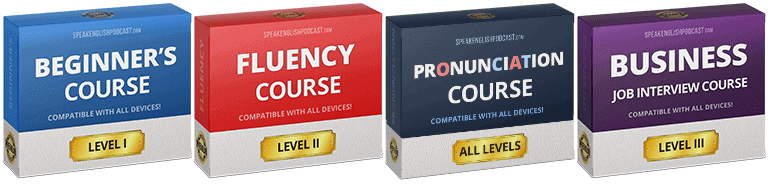
Continue practicing with my complete English courses. Choose the course that fits your level and goals, and learn to speak more naturally and confidently.
GRAMMAR MADE EASY
POV Story: Grammar in Context
Read the same story in two different points of view and notice how the grammar changes naturally.
| 01 |
First version Past Tense - First Person |
My refrigerator broke, and I needed a new one. So I thought I'd go to the nearest appliance store. I was a little nervous because I didn't want the food to spoil.
I drove my car to the place and parked nearby. I entered the store quickly and saw someone I assumed was an employee. I didn't know what refrigerator to buy, so I asked him about the models on display there.
The employee told me that he didn't know much about refrigerators and therefore couldn't help me.
I was angry because I thought the store had terrible service. How could a shop assistant not be able to give me advice!
A customer had to be able to ask about the differences between the models they were selling!
However, something happened. I realized that this so-called shop assistant didn't work there. He was simply a customer like me.
Given the situation I was in, I was very embarrassed. Since then, I try not to assume anything, and if a shop assistant asks me if I need help, I ask him if he is a customer. And they always look surprised.
| 02 |
Second version Past Tense - Second Person |
Your refrigerator broke, and you needed a new one. So, you thought you'd go to the nearest appliance store. You were a little nervous because you didn't want the food to spoil.
You drove your car to the place and parked nearby. You rushed into the store and saw someone you assumed was a shop assistant.
Since you didn't know which refrigerator to buy, you asked him about the models on display there. The employee answered that he did not know much about refrigerators and, therefore, could not help you.
You got angry because you thought the store had lousy service. How could a shop assistant not be able to give you advice! A customer had to be able to ask questions about the differences between the models they were selling!
However, something happened. You realized that this so-called shop assistant didn't work there. He was simply a customer like you.
Given the situation you've experienced, you were very embarrassed.
Since then, you try not to make assumptions, and if a shop assistant asks you if you need help, you ask him if he is a customer. I don’t know why they always look surprised. 🙂
Thanks for listening, and I’ll see you in the next episode.
Review
Vocabulary
Review the most useful words and expressions before listening again.
interrupt
speak while another person is still talking.
lose track
forget the point you were making.
change the subject
start talking about a different topic.
show off
try to impress people.
be right
have the correct opinion or answer.
formal setting
a serious or professional situation.
ruin the moment
spoil an experience.
uncomfortable conversation
an interaction that makes people feel uneasy.
Continue practicing with my complete English courses. Choose the course that fits your level and goals, and learn to speak more naturally and confidently.