Episode 160
Listen to the Episode
Listen once for the main idea. Then use the transcript and repeat useful sentences aloud.
Download and study
Episode Resources
Download a file or continue to the transcript.
Best order: listen once, read while listening, then listen again without the text.
This episode revisits an earlier Speak English Now lesson: Episode 031 — English Riddles.
Full lesson
Read the Transcript
Follow the text while you listen, then repeat useful sentences aloud.
Hi, everybody! I am Georgiana, your English teacher and founder of SpeakEnglishPodcast.com. My mission is to help you speak English fluently.
Today you are going to learn English in a fun way.
You will learn new English vocabulary through fun riddles.
And with a mini-story, you will improve your fluency by answering lots of questions.
Let’s start!
One thing is clear. You want to become fluent in English. That's why it's a great idea to get to know the typical expressions and riddles.
Riddles often make us laugh out loud. Everyone knows that laughter is healthy because it relaxes the brain and body, helps us release stress, and promotes positive mental health. This way you will learn English more easily.
So I'm going to start telling you some riddles.
First, I'll tell you the riddle, and then I'll wait 10 seconds to give you time to answer. But don't worry. If you need more time, you can pause the audio.
Remember that on my website SpeakEnglishPodcast.com you will find the transcript of this episode.
Let's start!
Think about it,
1) What has to be broken before you can use it?
I'll give you a hint. It's something to eat.
Answer: An egg.
Yes, of course, it's an egg, I don't know about you, but I always remove the eggshell before eating it.
Let's continue.
2. I'm tall when I'm young, and I'm short when I'm old. What am I?
I'll give you a hint. It's something you can see in the dark.
Answer: A candle.
Yes, of course, it is a candle; as the candle burns, it gets shorter. Although this also happens with people. We also lose height as we get older.
3. What month of the year has 28 days?
Answer: All of them
That's right; all months have at least 28 days. Although in a leap year, the extra day is added to the end of February, making it 29 days instead of 28.
4. What is full of holes but still holds water?
Answer: A sponge
If there is a hole in a glass or bucket, the water comes out, but the sponge will absorb the water even though it has holes in it.
5. What can you break, even if you never pick it up or touch it?
Answer: A promise.
In English, we keep or break a promise. If you don't keep your promise, you break it.
6. What goes up but never comes down?
Answer: Your age
Yes, we always get older but never younger. Our age always goes up and never comes down.
7. What gets wet while drying?
Answer: A towel
If anything needs to get wet, it's a towel. That's what we have them for.
8. What can you keep after giving it to someone?
Answer: Your word
If you keep your word, it means you will do what you promised. It’s a typical English expression.
9. I shave every day, but my beard stays the same. What am I?
Answer: A barber
Well, if you are a man, this was an easy one for you. Of course, a barber can shave all day long and keep his beard the same.
This is the last one:
10. What has many keys but can't open a single lock?
Answer: a piano
Yes. The standard piano has 88 keys. However, we can't open any locks with them.
Now let's continue with a mini-story.
Now, let’s practice.
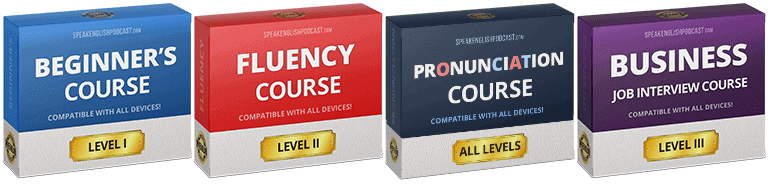
Continue practicing with my complete English courses. Choose the course that fits your level and goals, and learn to speak more naturally and confidently.
IMPROVE YOUR SPEAKING
Mini-Story: Speaking Practice
Answer the questions aloud with short and quick responses. Repeat the Mini-Story several times to improve your speaking and listening.
Jack was a very successful comedian who made people laugh hard.
Was Jack a musician?
No. No. Jack was a comedian.
Was he unsuccessful?
No. No. Jack wasn't unsuccessful. He was a successful comedian.
Did Jack make people cry?
No. No. Jack didn't make people cry. He was a comedian; therefore, he made people laugh.
Who was a comedian?
Jack was a comedian, and he made people laugh hard.
He was so hilarious that people started laughing after hearing his first line.
Was Jack's mom hilarious?
No. No. Jack's mom wasn't hilarious. Jack was a hilarious comedian.
Did people start laughing after hearing his second line?
No. No. People started laughing after hearing his first line.
Who started laughing?
People. People started laughing after hearing his first line.
So Jack was used to having a single line prepared before a show.
Was Jack used to having a song ready?
No. No. Not a song. Jack wasn't a musician. He was a comedian.
How many lines was Jack used to having before a show?
A single line. Jack was only used to having a single line prepared before a show.
But one day, he found himself in front of a very tough audience. They refused to laugh at his jokes.
Where did he find himself? In front of a mall?
No. He found himself in front of an audience.
Was the audience cheerful?
No. No. The audience was tough.
Did the audience refuse to listen to Jack?
No. No. The audience didn't refuse to listen to Jack. They refused to laugh at his jokes.
Since he had nothing prepared, Jack started telling riddles and interacting with people.
Was Jack very well prepared for the show?
No. No. Jack had nothing prepared. He wasn't used to preparing before a show.
Did Jack start telling mini-stories?
No. No. Jack didn't start telling mini-stories. He started telling riddles.
Did he interact with the people?
Yes. Jack started telling riddles and interacting with people in the audience.
In the end, Jack made the audience laugh so hard that many laughed for a year.
Did Jack make the audience angry?
No. No. Jack was a very famous comedian. He didn't make the audience angry; he made them laugh.
Did the audience stop laughing after Jack was done telling the riddles?
No. No. The audience did not stop laughing after Jack was done telling the riddles. Many of them laughed for a whole year.
Thanks for listening, and I’ll see you in the next episode.
Review
Vocabulary
Review the most useful words and expressions before listening again.
Riddle
A question or puzzle that makes you think before guessing the answer.
Hint
A small clue that helps you find an answer.
Eggshell
The hard outer covering of an egg.
Leap year
A year with an extra day in February, making February 29 days long.
Sponge
A soft material full of holes that can absorb and hold water.
Break a promise
To fail to do something that you promised to do.
Keep your word
To do what you said or promised you would do.
Barber
A person whose job is cutting or shaving hair, especially men's hair.
Continue practicing with my complete English courses. Choose the course that fits your level and goals, and learn to speak more naturally and confidently.