Episode 158
Listen to the Episode
Listen once for the main idea. Then use the transcript and repeat useful sentences aloud.
Download and study
Episode Resources
Download a file or continue to the transcript.
Best order: listen once, read while listening, then listen again without the text.
Full lesson
Read the Transcript
Follow the text while you listen, then repeat useful sentences aloud.
Hi, everybody! I am Georgiana, your English teacher and founder of SpeakEnglishPodcast.com. My mission is to help you speak English fluently.
Today I will tell you how to train your brain to listen more in English.
Nowadays, we are very used to watching content on the Internet. There is a wide variety of materials.
And when it comes to learning English, it is no exception, so I understand that you can feel overwhelmed by so many possibilities.
That's why I'm here, to give you clarity and to help you speak English in a very short time and with a very efficient method.
While most teachers switch from audio to video, I have done the opposite.
There are several reasons why I have stopped making videos regularly. I started making videos a decade ago. Meanwhile, I was teaching English one on one to students from all over the world and of all ages.
That's how I came up with the best method to learn English.
I noticed that when my students were listening to simple audio repeatedly, they were learning faster, and their listening and speech improved.
I've realized that many students learn with their eyes and not with their ears. Listening was a greater challenge than reading for many.
If you want to understand a language better, you need to train your brain to listen more.
Another aspect that has helped me understand what my students really need was the fact that I'm a polyglot.
I started learning several languages when I was a kid, by using different techniques. For me, the most effective way to learn a language was to learn by listening.
With my podcast, you will improve your listening and comprehension, especially if you listen repeatedly.
Most students think that the more variety, the better.
So what they usually do is listen to an audio once or twice and then change to something else.
Well, variety is useful, but what you want is to consolidate what you listen to; if you want to train your brain to listen, the most effective way to achieve this is through repetition.
For example, you can use one of my podcast episodes. I recommend that you listen to every episode several times to consolidate the content.
Because of time limitations, you can only try my method using the podcast. However, I can hardly develop the lessons.
Let's continue with a mini-story.
Now, let’s practice.
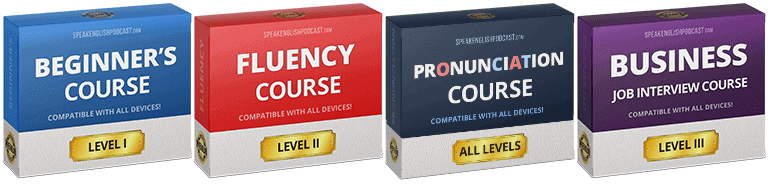
Continue practicing with my complete English courses. Choose the course that fits your level and goals, and learn to speak more naturally and confidently.
IMPROVE YOUR SPEAKING
Mini-Story: Speaking Practice
Answer the questions aloud with short and quick responses. Repeat the Mini-Story several times to improve your speaking and listening.
Tom wanted to learn to speak English fluently on his own.
What did Tom want to learn? Spanish?
No. No. Tom didn't want to learn Spanish. He wanted to learn English.
Did he want to learn how to write in English?
No. He wanted to learn how to speak English.
Tom went to a language school. Right?
No. No. Tom didn't go to a language school. He wanted to learn English on his own.
On his own or in a group?
Not in a group. Tom wanted to learn English on his own.
He found out that he had to repeat the same content many times.
Did Tom find out something?
Yes. He found out something.
He found out that he had to repeat something. Right?
Yes. He found out that he had to repeat the same content.
Who found out something?
Tom. He found out something about how to learn English.
Only one time or many times?
Many times. Tom found out that he had to repeat the same content many times.
Tom started listening and repeating the same sentence for a month.
Did Tom listen to music?
No. No. Tom didn't listen to music.
Tom started listening to his friends. Right?
No. Tom started listening to a sentence.
Did he listen to the same sentence for a year?
No. No. He only listened to the same sentence for a month.
After a year, Tom was able to speak English fluently and had perfect pronunciation.
Was Tom able to speak Japanese?
No. No. Tom wasn't able to speak Japanese. He was able to speak English.
After how long was he able to speak English?
After a year. Tom was able to speak English fluently after one year.
Was he able to speak fluently?
Yes. He was able to speak English fluently.
Was his pronunciation horrible?
No. No. His pronunciation wasn't horrible. His pronunciation was perfect.
The problem was that he only learned twelve sentences in English.
Tom had a problem. Right?
Yes. He had a big problem.
Did Tom learn 1200 sentences in English?
No. No. Tom didn't learn 1200 sentences in English. He only learned 12 sentences.
He only repeated one sentence for a month. That's why he only learned twelve sentences.
Thanks for listening, and I’ll see you in the next episode.
Review
Vocabulary
Review the most useful words and expressions before listening again.
Overwhelmed
Feeling that there are too many choices or too much information to deal with easily.
Switch
To change from one thing to another; the episode mentions teachers switching from audio to video.
One-on-one
Involving one teacher and one student working directly together.
Repeatedly
Again and again; the episode recommends listening to the same audio many times.
Polyglot
A person who speaks or studies several languages.
Variety
A range of different materials or options.
Consolidate
To strengthen what you have learned so it becomes more secure and familiar.
Repetition
Doing or hearing the same thing again and again to improve learning.
Continue practicing with my complete English courses. Choose the course that fits your level and goals, and learn to speak more naturally and confidently.